
Dendritic Opal vs Dendritic Agate – Key Differences Guide
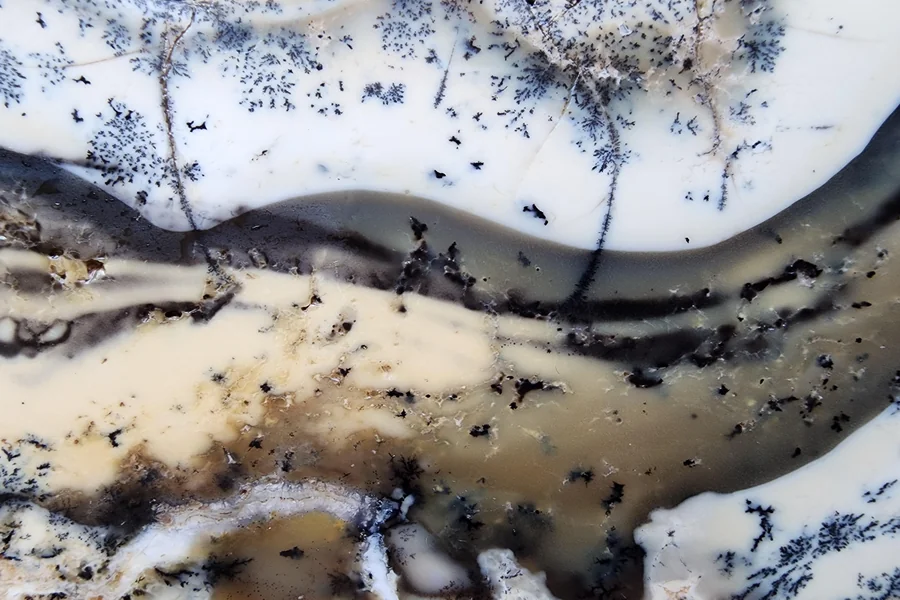
Dendritic Opal vs Dendritic Agate is a subject of comparisons that tumbles many an amateur collector of gems and crystal lovers. The beautiful branch patterns are present on both the stones and appear as the tiny trees or ferns which are confined within the stone. These are known as dendrites and produce natural artwork in the mineral and render both the stones very attractive to the jewelry and collectors.
The two gemstones may appear almost the same at the first look. They both have dark branching inclusions with a light background, and thus people can easily confuse one of them. But they are in fact distinct minerals that have been formed in different geological processes.
Dendritic Opal is a member of opal family and it is made up of hydrated silica. Dendritic Agate in its turn is a type of chalcedony that is a microcrystalline structure of quartz. These variations have an impact on their hardness, durability, appearance, and the general structure.
The knowledge about the formation of these stones and the distinction between them can let the collectors pick the proper form of stone to make a jewelry or a mineral collection. In this guide we are going to look at the properties of each stone and how they can be distinguished.
What Is Dendritic Opal?
Dendritic Opal is a form of common opal which is composed of naturally occurring patterns of branching in the form of mineral inclusions. The color of the stone background typically is white, cream or light gray, and the dendritic patterns are dark brown or black.
The term dendritic is translated as tree in Greek and the inclusions are of perfect shape to be referred to as trees. These designs resemble small plants or branches that are dispersed over the surface of the stone.
Contrary to the valuable opal, dendritic opal does not typically exhibit rainbow color flashes referred to as play of color. Rather, it is beautiful because of the contrasting color between the light background and the delicately formed patterns.
These dendrites are normally created by the manganese or iron oxide minerals which oozle into the cracks in the stone during creation. The minerals eventually crystallize into the form of branches that become mini landscapes.
Dendritic opal is commonly made into cabochons as jewelry due to the patterns appearing in the stone like paintings of nature.
What Is Dendritic Agate?
Agate in Dendritic is a type of chalcedony also comprising of branching mineral inclusions. Similar to dendritic opal, the designs appear to be trees, moss or ferns embedded in the gemstone.
Dendritic agate is normally made in a base color of translucent or milky white. With this background, the dark dendrites can be seen as natural designs that are fine, which can be found throughout the stone.
The manganese or iron deposits that penetrate the stone when forming it normally cause the dendritic patterns of the stone. These minerals move through minute fissures in the rock and gradually crystalize in the form of branches.
Agate is formed in volcanic rocks or cavities when mineral rich deposits of water keep building layers of silica. This may require thousands, or even millions of years.
Dendritic agate is harder and tougher than opal since it is a member of the quartz family. This is very durable and makes it a favored type of rings, pendants, and other jewelry items.
The dendritic agate is valued by collectors owing to the fact that each stone has its own style that is likened to a work of nature.
Dendritic Opal vs Dendritic Agate: Visual Differences
The dendritic pattern is, obviously, the most evident similarity of the two stones. Both rocks have branching mineral inclusions which appear in the form of small trees or plants.
Nonetheless, there are little visual distinctions which may be used to determine which stone is which.
Dendritic opal is generally opaque. Its history is usually creamy or porcelain as opposed to transparent.
Dendritic agate is more transparent. The light can penetrate the stone to some extent, particularly near the edges, to make it look more like glass.
The other difference is the sharpness of the dendrites. The branching patterns are sharp and well defined especially in agate due to crystal structure of the stone.
In opal the patterns can appear softer or can be a little diffused with the light interacting with the inside structure.
These slight dissimilarities can be better observed when you place the two stones one beside the other.
Geological Formation and Composition
The primary distinction between the Dendritic Opal and Dendritic Agate comparison is the geological composition.
Dendritic opal is made out of hydrated silica in that, it has water confined in its structure. This water content may be different according to the conditions of the formation.
Due to this structure opal is normally soft than the quartz based minerals. Even in the long term some opals can even end up losing moisture when subjected to extreme environments.
Dendritic agate is made out of microcrystalline quartz which is far more steady and resilient. The agate silica crystalizes into very minute particles forming a powerful stone.
The two stones have a similar mechanism of forming dendritic inclusions. Mineral endowed water fills a fissure in the stone where it solidifies into branch structures, which contain either manganese or iron.
Although the pattern formation is the same, the mineral of the host is totally different.
Durability and Use in Jewelry
In deciding on which of the two stones to use in jewelry, durability is a factor.
Dendritic agate tends to be harder as it is of the quartz family. Quartz has a hardness of about 6.5 to 7 in the Mohs hardness scale hence it is resistant to scratches and can be used in the daily life.
Dendritic opal is less hard and it is normally between 5.5 and 6 in the hardness scale. Due to this it has to be handled more carefully.
Dendritic agate can be more suitable especially with jewelry, such as rings or bracelets, which are in contact frequently.
Dendritic opal continues to be applied in jewelry although it is now common in pendants, earrings or items that are less prone to severe impact.
The two stones are normally cut into cabochons instead of being faceted gems since the beautiful dendritic patterns are brought to the fore by the flat polished surface.
Symbolism and Appeal to Collectors
Dendritic opal and dendritic agate are both considered beautiful due to their appearance in art. The natural patterns also tend to be miniature landscapes or forest that are trapped within the stone.
Such gemstones are valued by many collectors who find no two items that are completely identical. The patterns of each of the stones are different due to nature growth of minerals that branch.
The crystal traditions tend to attribute the growth, stability, and attachment to nature to the dendritic stones. The tree figures represent the growth and balance of nature.
These stones also offer artists and jewelry designers the benefit of having their patterns look like paintings or botanical drawings.
This is a particular artistic trait, which contributes to their popularity as custom jewelry works and collector pieces.
Final Thought
Dendritic Opal vs Dendritic Agate is the intriguing comparison of two gemstones which have the similar patterns but are different in their structure and in their durability. The two stones have gorgeous dendritic inclusions making the minerals look like trees or branches.
As the primary distinction, their composition is different. Dendritic opal is hydrated silica of a softer structure and dendritic agate is also quartz based and much more durable.
Although these may be the differences both these stones are appreciated very much because of their natural beauty. Their complex structures turn simple minerals into tiny art works that have been formed by geological processes during a long period of time.
Whether it is dendritic opal which has a soft look or dendritic agate which is strong, clear, and beautiful, both of the gemstones are a brilliant demonstration of the brilliance of nature.
FAQs
What is the main difference between dendritic opal and dendritic agate?
The main difference is their composition. Dendritic opal is hydrated silica while dendritic agate is a variety of quartz known as chalcedony.
How can you tell dendritic opal and dendritic agate apart?
Dendritic opal usually appears more opaque while dendritic agate tends to be more translucent and slightly glassy.
Are dendritic patterns natural in these stones?
Yes. The branching patterns form naturally when minerals such as manganese or iron crystallize inside the stone.
Is dendritic agate stronger than dendritic opal?
Yes. Dendritic agate is generally harder and more durable because it belongs to the quartz family.
Are dendritic opal and dendritic agate used in jewelry?
Yes. Both stones are commonly polished into cabochons and used in pendants, rings, and decorative jewelry pieces.