
Pink Calcite vs Rose Quartz – Key Differences Explained
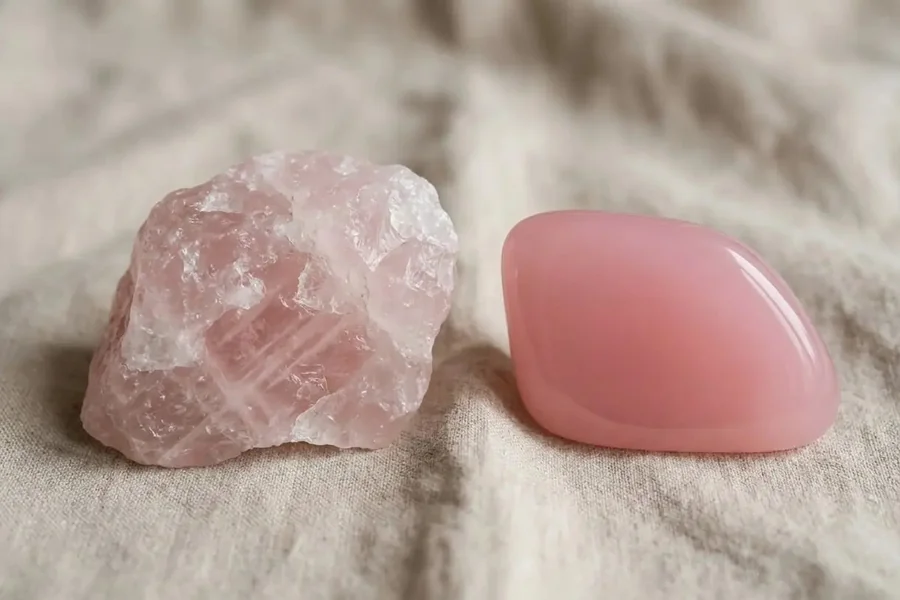
The pink gems have attracted the attention of the collectors and the crystal lovers since ages. Pink calcite and rose quartz are some of the most popular pink minerals. They seem to be quite similar at first sight since both of them are colored in soft pink and are frequently used as decorative stones or in spiritual matters. But in the comparisons Pink Calcite and Rose Quartz, one can notice several significant distinctions.
The rocks are different in terms of geological origins and physical characteristics. They also differ in terms of hardness, crystal structure and general appearance. Learning about these variations may enable the collectors to place the stones in their right places and enjoy the way the stones were created in nature.
Whether someone is interested in mineral collecting, jewelry making, or simply learning about crystals, understanding Pink Calcite vs Rose Quartz provides valuable insight into two beautiful minerals that share similar colors but very different characteristics.
Understanding Pink Calcite
Pink calcite is a form of calcite which is a mineral containing calcium carbonate. Calcite is a mineral that occurs in most geological settings such as sedimentary rocks, caves and hydrothermal deposits.
The calcite tends to be pink in color due to impurities of manganese or other minerals that get entraped in the process of forming the crystals. These contaminates form the soft pink colours that attract the collectors of the stone.
Pink calcite is normally found as massive formation and not as individual crystal points. It is usually clouded or slightly transparent with soft color shades all through the stone.
Calcite is quite soft which is one of its significant features. Calcite has a Mohs hardness of about 3 and this implies that it is easily scratched when compared with most other minerals.
Due to this tenderness, pink calcite is commonly employed as a source of ornamental carvings, polished stones, or display pieces instead of the long lasting jewelry.
Understanding Rose Quartz
Rose quartz is a type of quartz which is among the most common minerals available in the crust of the earth. The mineral rich fluids that are formed in deep underground crystallize to form crystals of silicon dioxide, thus forming quartz.
It is considered that microscopic inclusions of minerals like titanium or manganese are the reason why rose quartz has a pink color. There are also scientists who propose that the fibrous mineral structures in the stone can be the reason of its color.
Rose quartz is also much harder, in comparison to calcite. It is approximately 7 on the Mohs scale of hardness thus it is much harder to scratch or wear out on daily use.
The rose quartz is not in the form of clear crystal points, but in massive forms. It has either a very pink color or deeper rosy color based on the composition of the mineral.
Due to its strength and beautiful color, rose quartz finds much application in jewels, sculptures, and ornamental stone pieces.
Physical Differences Between Pink Calcite and Rose Quartz
Comparing between Pink Calcite and Rose Quartz, there are some physical attributes that could be used in identifying each stone.
Hardness is also one of the most conspicuous distinctions. Calcite is very tender compared to quartz and this implies that it gets scratched easily by a metallic object or even by a copper coin. Rose quartz is much more difficult, and it takes more material to scratch the surface of it.
Crystal structure is another difference. Calcite is trigonal crystal system but when crystals grow, they tend to encircle rhombohedral forms. Quartz exists in the form of hexagonal crystal structure yet rose quartz is normally massive.
Transparency is also a variable. Pink calcite is usually cloudy or opaque whereas the rose quartz is more translucent.
It is these physical differences that cause it to differentiate between the two stones even when their colour is similar.
Color and Visual Appearance
The color contributes significantly in the comparison between Pink Calcite and Rose Quartz. The colors of the stones are pink, although their color and appearance can vary.
Pink calcite is usually soft pastel pink with slight milky or chalky appearance. Other works have faint banding or cloudy marks on the stone.
Rose quartz tends to be more homogenous in distribution of color. The shade of pink can be both light blush and deep rose, and the stone can be rather slightly translucent.
The other aesthetic difference is the surface texture of the stone when it is polished. The calcite is usually softer and even waxy in nature as it is less hard.
The crystal structure of rose quartz is commonly glassy or vitreous in nature, and thus, when polished it has a glassy or vitreous lustre owing to its composition of the mineral quartz.
These visual indicators make the collectors recognize each mineral with ease.
Geological Formation and Locations
These stones are also different in geological settings in which they are formed. Pink calcite is often deposited in the sedimentary setting when calcium carbonate is deposited over time.
Calcite can also be formed in limestone caves and high mineral rich hydrothermal systems. In other localities pink calcite is found in huge blocks in the mineral veins.
Rose quartz is igneous, and it especially occurs in pegmatites. Pegmatites are coarse grained rocks formed in the end of the cooling of magma.
Brazil, Madagascar, and South Africa are some of the countries where some of the largest deposits of rose quartz are found. These areas have large pegmatite deposits in which the quartz crystals may form.
Despite the fact that both the stones are created deep in the earth, their geological formation is very different.
Uses in Jewelry and Decorative Objects
The other fascinating phenomenon of the Pink Calcite vs Rose Quartz is the use of the stones.
Due to its hardness and durability, rose quartz is also used in jewelry including rings, pendants and bracelets. It is easy to wear on a daily basis because of its resistance to scratch.
Most decorative carvings, sculptures or polished display pieces are typically made of pink calcite. It is not hard-wearing, which means that it is not a good material that can be used in jewelry with a lot of contact or abrasion.
The stones are also popular as a collection of crystal and in the interior decoration. They are attractive to the eye with their soft pink hue and can fit well into numerous decoration schemes.
It has been seen that collectors tend to value each stone according to their intended purpose.
Symbolic and Cultural Meanings
Despite the fact that the theme of Pink Calcite vs Rose Quartz is mostly scientific, both stones have a symbolic representation in most of the societies.
Rose quartz is traditionally related to the objects of love, compassion, and emotional stability. Historically it has been applied in jewelry and decorative items that are related to love and romance.
The pink calcite is at times related to emotional recovery and tranquility. Other individuals emulate this by putting the stone in their living rooms as a reminder of peace and harmony.
These symbolic meanings are very different in cultures and traditions. Although they do not belong to the category of scientific properties, they make these stones so popular in contemporary crystal collections.
Final Thought
Pink Calcite vs Rose Quartz is the comparison of two minerals, which are not alike and have very different geological origins and physical properties. The two stones are beautiful in pink color, which makes them appealing to the collectors and designers.
Nevertheless, the variations of their hardness, crystal structure, and formation environment show the interesting complexity of the mineral world of the earth. Rose quartz is more sturdy and is used as jewelry and pink calcite is softer and would be formed in forms of ornamental carvings.
The knowledge of identifying these differences will aid in collectors learning to enjoy each mineral because it has something to offer. Aesthetic or scientific, both stones have accessible to them their admiration as illustrations of the natural type, which they belong to, in the mineral kingdom.
FAQs
What is the main difference between Pink Calcite vs Rose Quartz?
The main difference is hardness because pink calcite is much softer while rose quartz is significantly harder and more durable.
How can you tell pink calcite from rose quartz?
Pink calcite scratches easily and often appears more opaque while rose quartz is harder and usually more translucent with a glassy shine.
Which stone is better for jewelry?
Rose quartz is better for jewelry because its higher hardness makes it more resistant to scratches and everyday wear.
Where is rose quartz commonly found?
Large rose quartz deposits occur in countries such as Brazil Madagascar South Africa and parts of the United States.
Is pink calcite rare?
Pink calcite is not extremely rare but high quality specimens with strong color may be valued by collectors.
Why are both stones pink?
Their pink colors come from different mineral impurities present during formation such as manganese or other trace elements.