
Purple Fluorite vs Amethyst – Key Differences Explained
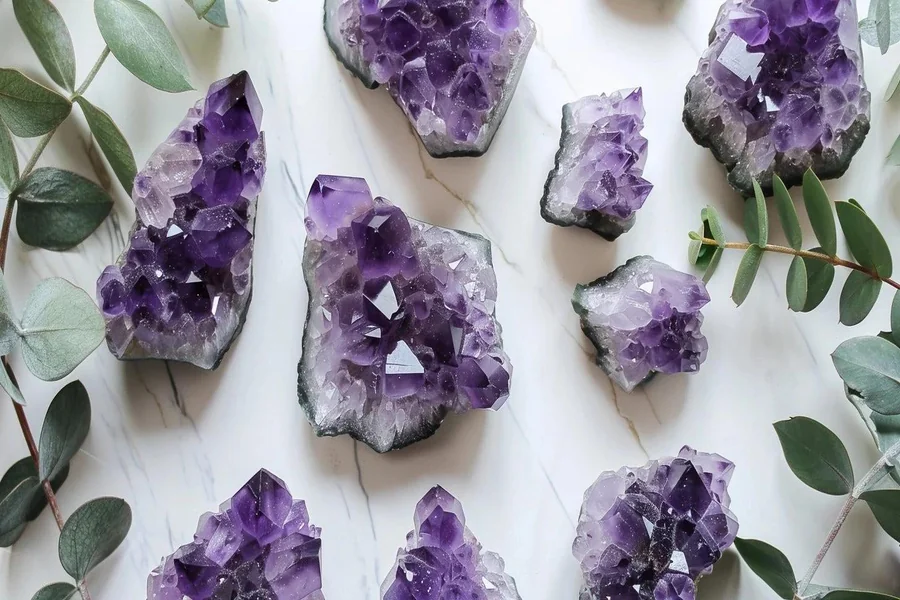
Purple Fluorite vs Amethyst is a comparison that often comes up among gemstone collectors, jewelry buyers, and mineral enthusiasts. These two stones are beautiful in purple color and may look closely resembling each other at the first sight. Due to such resemblance, the two minerals are often mixed up by many, particularly when they are cut or polished to make jewelry. Nonetheless, purple fluorite and amethyst are totally different minerals which possess different chemical formulas, crystal structures and physical characteristics.
Amethyst is a widely recognized form of quartz and it has been in jewelry since thousands of years ago. Purple fluorite on the other hand is an integral part of fluorite mineral family and is valued due to its bright colors and cubic crystal formations. Although both stones may have color varieties that vary between light lavender to dark violet, durability and formation conditions differ greatly in both stones.
This knowledge about the distinctions between the two minerals can assist any collector to refer to them properly and recognize their special features. Here we are going to look into their geological, physical, appearance and their comparison in the gem stone market.
What Is Purple Fluorite?
The purple fluorite is a type of fluorite which is a mineral consisting of calcium fluoride. It is created in hydrothermal veins as mineral rich fluids flow through cracks in rocks and crystals are deposited as it cools off.
A crystal structure is one of the most well-known properties of fluorite. The mineral tends to grow in cubic or octahedrally shaped forms hence having a characteristic geometric look on natural specimens.
The trace elements and structural defects in the lattice of purple fluorite give it its color. The impurities react with natural radiation or chemical reactions in the formation to produce violet or purple color.
Fluorite is identified with an extensive variety of colors either green, yellow, blue, or purple. Nor are some not found to exhibit many colors simultaneously in the same crystal.
Though fluorite may be very clear and beautiful, it is relatively tender as compared to most gemstones. Due to this flexibility, it is typically worn in showcases or more as an intermittent ornamental feature as opposed to daily use.
What Is Amethyst?
Amethyst is a purple colored form of quartz and it is among the most popular gemstones in the world. Quartz is a silicon dioxide mineral and is found in a very broad geological setting including volcanic rocks, hydrothermal veins and geodes.
The amethyst purple is produced due to the presence of traces of iron and natural radiation of the surrounding rocks. These bring a change in crystal structure and give the typical purple color.
Amethyst crystals are also regularly shaped in a hexagonal form topped by sharp ends. A large group of amethyst crystals often occurs in holes found in rocks referred to as geodes.
Amethyst is used in jewelry like rings, necklaces and bracelets due to the fact that quartz is relatively hard and durable.
Within major sources of amethyst, there are Brazil, Uruguay, Zambia, and some regions in Russia. This gemstone is very popular and has large deposits worldwide wherein the jewelry designers have been using it.
Purple Fluorite vs Amethyst: Visual Differences
One of the most noticeable differences in the Purple Fluorite vs Amethyst comparison is the crystal shape. The crystals are normally in forms of cubes or octahedrons making them appear burdensome.
The amethyst crystals are usually in the shape of long hexagonal prisms with pointed endings. Quartz minerals are likely to have these shapes and they are readily identifiable in the natural crystal clusters.
Clues can also be given by variations of color. Purple fluorite can be lighter or more transparent in color and sometimes it can have color zoning whereby various layers of color are found within the crystal.
Amethyst tends to exhibit more homogenous violet hues that are of a light lavender to a deep violet shade.
The other visual disparity is clarity. The crystals of fluorite might be very transparent but they can also have internal fissures. Amethyst crystal is usually slightly cloudy or have inclusions in the quartz.
These properties aid the collectors to tell the two minerals apart.
Hardness and Durability
One of the most significant physical differences of these stones is hardness. Fluorite has a hardness of approximately 4 as per the Mohs scale implying that it is not very hard and can easily be cut by many other minerals.
Amethyst has an approximate position of 7 on Mohs scale since it is a form of quartz. It is much more durable and scratch resistant due to this increased hardness.
Due to its tenderness, fluorite can easily get damaged when worn in rings, or other jewelry that is subjected to a lot of wear.
Amethyst is more durable and should be used as a daily jewelry.
The various hardness variations have an important role in the use of each stone in the gemstone market.
Formation and Geological Origins
The geological conditions under which these minerals are formed are also different.
Fluorite normally occurs in hydrothermal veins where crystalline minerals are deposited along the cracks in the rock formations by the deposition of hot mineral rich fluids. These environments are typical close to metals ore deposits like the lead and zinc mines.
The amethyst is formed in the cracks of the volcanic rocks or even in the hydrothermal systems where the silica rich fluid slowly crystallizes over time. The volcanic regions form the large amethyst geodes in places where the bubbles of gas in the lava left holes in the formation.
The chemical conditions under which the minerals could be formed differ, although both of them could be found in the hydrothermal conditions.
These variations are the reason why fluorite and amethyst are not often found to grow in the same geologic environment.
Uses and Market Value
Amethyst and purple fluorite are used as gemstone and mineral respectively.
Amethyst is commonly used in jewelry due to its durability, rich color and its accessibility. It may be shaped as a variety of jewel items, cut into various gemstones or polished cabochons.
Fluorite has a greater application as a collector mineral or decorative stone. The softness of it restricts its application in everyday jewelry though there are instances where some are cut into pendants or earrings.
Amethyst is also more prevalent, but as a gem, it is still very popular. Extremely colored and distinctly formed crystals of fluorites can be considered as prized by the collector as well.
All the two minerals are beautiful and pleasing to the eye although they have varied application basing on their physical characteristics.
Final Thought
Purple Fluorite vs Amethyst highlights how two minerals with similar colors can differ greatly in composition, hardness, and geological origin. Although both stones have beautiful purple colors, they are differentiated in terms of their crystal structure and strength.
Fluorite is a beautiful cube crystal, and is an admirable material because of its color and transparency. Amethyst is a durable quartz gemstone that has been one of the most popular stones of purple that have been used in jewelry.
To the collector and lovers of gemstones, this knowledge of the difference will guarantee the right identification and value of the distinctive characteristics of each type of mineral.
FAQs
What is the main difference between purple fluorite and amethyst?
Purple fluorite is a calcium fluoride mineral with cubic crystals, while amethyst is a quartz gemstone with hexagonal crystal structures.
Which stone is harder fluorite or amethyst?
Amethyst is harder with a Mohs hardness of about 7, while fluorite is much softer at around 4.
Can purple fluorite be used in jewelry?
Yes. It can be used in jewelry but is less durable than amethyst and is better suited for pieces with limited wear.
How can you tell fluorite and amethyst apart?
Fluorite often forms cubic crystals and may show color zoning, while amethyst forms hexagonal crystals with pointed tips.
Is amethyst more valuable than fluorite?
Amethyst is more commonly used in jewelry, but high quality fluorite crystals can also be valuable to mineral collectors.