
Bumble Bee Jasper – Meaning Formation and Uses
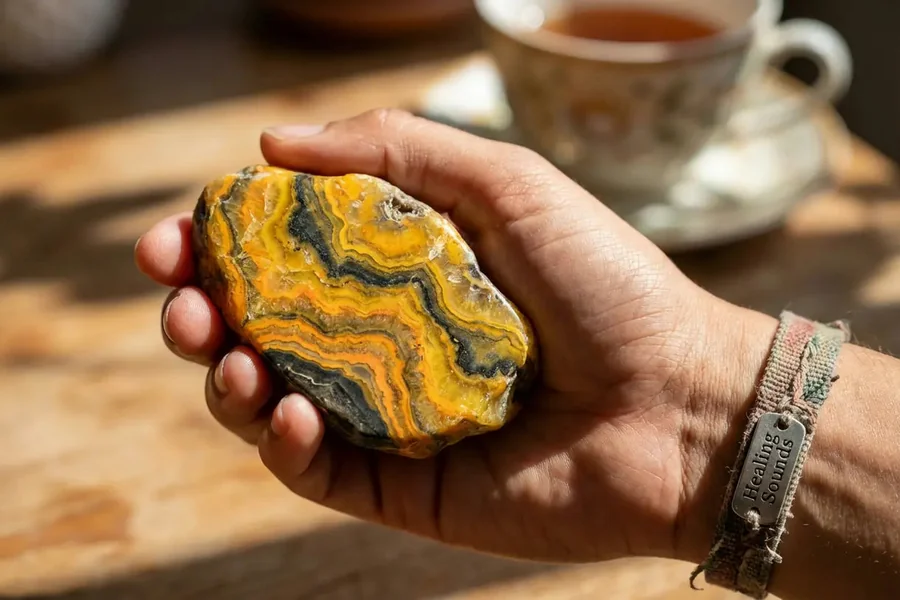
Bumble Bee Jasper is one of the most striking and unusual stones found in the mineral world. The stone is known by the bright pattern of yellow, orange and black which resembles the stripes of bumblebee. Because of this unique appearance, Bumble Bee Jasper has become popular among collectors, jewelry makers, and mineral enthusiasts who appreciate its dramatic colors and natural patterns.
Despite its name, Bumble Bee Jasper is not technically a true jasper. Rather, it is a complicated mineral structure that is formed due to volcanic eruptions and mineral deposits. The stone has layers of other minerals like sulfur, calcite and arsenic compounds that give the layers the specific color they have.
Understanding Bumble Bee Jasper involves looking at how it forms, where it is found, and why it has gained attention among gemstone collectors. It is one of the most familiar minerals in the mineral world due to its unique structure and colorful markings.
What Is Bumble Bee Jasper
Bumble Bee Jasper is a colorful mineral formation composed of several different minerals layered together. These layers produce bold patterns which are usually bright yellow, deep orange, gray and black bands.
Even though it is called jasper, the rock is not a part of the quartz family as the conventional jasper types. Rather, it develops due to the mineral deposits in volcanic settings whereby the hot gases and mineral rich fluids interplay with the adjacent rock.
The bright yellow color in Bumble Bee Jasper usually comes from sulfur, while darker areas may contain manganese oxides or other minerals. Within the stone, calcite is also found and helps in the laid structure of the stone.
It is a dramatic and striking stone with both banding and swirling patterns. The works are one-of-a-kind, which is incredibly attractive to the collectors and decoration purposes.
Geological Formation of the Stone
The formation of Bumble Bee Jasper is closely linked to volcanic activity. The stone structures are around volcanic vents whereby the hot gases are released through the surface of the earth.
The reaction of these gases with mineral rich water and the rock around resulting in chemical reaction forms a layer of various minerals. With time these layers become hardened into stone.
The mineral is bright yellow and this has been attributed to the presence of sulfur during this process. Darker hues are added to the colors by other components like iron and manganese.
Since the stone is formed in the active volcanic conditions, the process may be complicated and may include a number of steps of the mineral deposition.
The layered structure of Bumble Bee Jasper reflects these stages, with each color band representing a different mineral deposit formed at a specific time.
Where Bumble Bee Jasper Is Found
Bumble Bee Jasper is primarily found in Indonesia, particularly near volcanic regions on the island of Java. These are geothermal regions that harbour conditions that allow the formation of the stone.
The mineral deposits are found close to the fumaroles which are holes in the crust of the earth that secrete the volcanic gases. These gases also contain minerals which crystallize and end up becoming layered stones.
Since the stones are only formed in certain volcanic settings, they are said to be relatively rare compared to other common gemstones.
Mining Bumble Bee Jasper can also be challenging due to the remote and sometimes hazardous locations where it forms.
Nevertheless, these problems still do not eliminate the great demand of the stone among the collector community due to its unusual colors and patterns.
Appearance and Physical Characteristics
One of the most distinctive features of Bumble Bee Jasper is its vibrant color pattern. The stone tends to have bright lines of yellow and orange alternating with black or gray spots.
These colors produce great contrasts which are like the stripes of bumblebee. The patterns can be in the form of layers or swirling forms or irregular spots depending on the manner in which the minerals were formed.
When it is polished, the stone is smooth and may exhibit a shiny surface that augments its high colors.
In terms of hardness, Bumble Bee Jasper is relatively soft compared with quartz based gemstones. Due to this, it should be taken with care so as not to get scratched or damaged.
Although soft, the dramatic look of the stone is popular in jewelry as well as decorative carvings.
Uses in Jewelry and Decoration
Bumble Bee Jasper is widely used in jewelry and artistic creations. Its color patterns are vibrant and thus suitable to pendants, earrings and cabochons.
The jewelers tend to cut the stone in smooth polished forms which emphasize the natural banding of the stone. Due to the fact that the patterns of each specimen are unique, each jewelry created out of the stone is unique.
Other decorative items that make use of the mineral include carved figurines, spheres, and exhibition stones. Due to their strange look, polished specimens are commonly stored in mineral collections by collectors.
Nevertheless, the stone is supposed to be treated responsibly when cutting or polishing since some minerals such as the arsenic compounds are found. Polished finished works are usually safe in the jewelry.
Such applications indicate the equilibrium of attractiveness and prudence of this weird mineral.
Cultural Interest and Symbolic Meaning
Beyond its geological significance, Bumble Bee Jasper has gained popularity in modern crystal collections. There are those who relate the stone with creativity, vigor and self-confidence.
Bright yellow and orange colors are regularly linked with the principles of positivity and liveliness. Due to these associations, the stone is occasionally utilized in meditation or decorative exhibits that are meant to establish a positive mood.
Though none of these symbolic meanings are scientific qualities, they add popularity to the stone in modern crystal culture.
Collectors also appreciate Bumble Bee Jasper simply for its natural beauty and unusual geological origin.
It is one of the most popular decorative stones in the mineral collections which are the combination of bright colors and rare formations.
Final Thought
Bumble Bee Jasper stands out as one of the most visually dramatic mineral formations found in nature. It bears bright yellow, orange and black patterns that are similar to the stripes of a bumblebee and it can easily be distinguished among the gemstones and mineral specimens.
The stone was formed in the volcanic conditions and under the influence of complicated mineral processes which reflect the great forces of the earth surface. It can be easily confused with jasper because it looks similar, but the composition and origin of this type of stone makes it rather distinct.
Collectors, jewelry designers, and geology enthusiasts continue to value Bumble Bee Jasper for its vibrant colors and distinctive patterns. Both artworks are natural works of the eruptions of the volcano and mineral deposits which took place throughout time.
FAQs
What is Bumble Bee Jasper?
Bumble Bee Jasper is a colorful mineral formation composed of sulfur, calcite, and other minerals that create bright yellow, orange, and black patterns.
Where is Bumble Bee Jasper found?
It is mainly found in Indonesia, particularly in volcanic regions where mineral rich gases create layered stone formations.
Is Bumble Bee Jasper a true jasper?
No it is not a true jasper because it does not belong to the quartz family despite its similar appearance.
Why is Bumble Bee Jasper colorful?
Its colors come from minerals such as sulfur, manganese oxides, and calcite that form layered patterns during volcanic mineral deposition.
Is Bumble Bee Jasper safe to wear as jewelry?
Yes polished pieces are generally safe to wear, although the raw stone should be handled carefully during cutting or polishing.
What is Bumble Bee Jasper used for?
It is commonly used for jewelry, decorative carvings, and mineral collections because of its striking appearance.