
Rocks That Glow in The Dark Naturally and Why They Shine
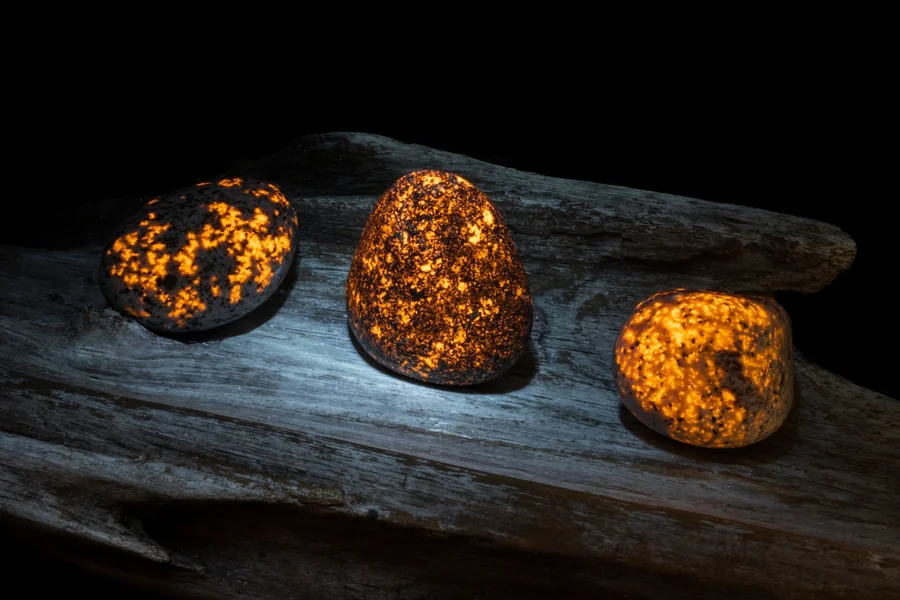
Naturally there are many who have been interested over the years in Rocks That Glow in the Dark. Most rocks look dull and lifeless at first glance, but in some circumstances, some minerals may display a glowing appearance to surprising effect. These fluorescent effects are brought about by some special chemical properties in the stone which reacts with light or energy.
The glow cannot be seen in the daylight in most cases. Rather these rock glow when exposed to ultraviolet light, heat or any other kind of energy. The color is soft green or blue to bright red, purple, or yellow with a different mineral composition.
Geologists and mineral collectors worldwide have been eager to study and understand the basis of this strange behavior. Fluorescent minerals are commonly exhibited in museums or in a personal collection where ultraviolet light is used so that one can see the obscure colors.
To know why these stones are glowing we need to take a look at the science of minerals and how they interact with energy. In this guide we are going to look at some of the natural rocks which exhibit glowing effects and why they glowing effects.
The Science Behind Glowing Rocks
The light that is observed in some minerals normally results due to a phenomenon called fluorescence or phosphorescence. These reactions entail the reaction of light or radiation energy and minerals.
Fluorescence occurs when a mineral absorbs the ultraviolet light and hence emits the found energy as visible light. The glow is visible in nearly no time that the UV light is cast over stone and disappears when the source of light is withdrawn.
Phosphorescence is a little different. In this example the mineral will be glowing even when the light source is taken away within a short time. This delayed glow is due to the fact that the energy is stored in the crystal pattern in the short run.
These effects are caused by some trace elements in the mineral structure. Elements like manganese, uranium, tungsten and rare earth elements have the ability to make minerals emulate visible light in the correct circumstances.
Such glowing effects render certain rocks to look near magical even though this has been explained by mineral chemistry and physics.
Fluorite: One of the Most Famous Glowing Minerals
Fluorite is also among the most common fluorescent minerals. It is present in an array of colors such as purple, green, blue and yellow. Many specimens of fluorite fluoresce under the ultraviolet light in bright colors and these colors are a good contrast to the natural color of the material.
The name of the mineral is due to the property of fluorescence itself. Early mineralogists observed that some crystals of fluorite were visible in the presence of an ultraviolet ray.
The crystals of fluorite are usually cubic with crystals that are either clear or translucent. There are even some specimens which have layers of different colors which are even more brilliant in UV light.
Due to its dominant fluorescent nature fluorite is often used in teaching and teaching demonstrations and mineral collections. There are especially lustrous glowing effects that attract the attention of many collectors in the form of fluorite.
Calcite: A Common Mineral with Hidden Glow
Another mineral that could fluoresce under ultra violet light is calcite. It is a globally widespread mineral that occurs in numerous geological formations such as caves and sedimentary rocks.
Even though calcite might seem common during the day, there are those specimens that give out glows of bright red, orange, pink or blue in case of ultraviolet light.
The trace elements of manganese or lead that are included in the crystal structure during formation give the fluorescent colours in calcite.
Calcite may develop in various forms such as rhombohedrons, scalenohedrons and massive forms. Calcite is also found in some of the cave formations such as stalactites and stalagmites.
The glow property of the mineral is quite fascinating to the collectors who are fond of looking at rocks in UV light.
Willemite: Bright Green Fluorescent Rock
Willemite is a mineral of zinc silicate that is well known due to bright green fluorescence. Upon being subjected to ultraviolet light willemite may fluoresce brightly as it appears with a vivid green look.
The mineral can be found as part of zinc ore deposits and could be in the presence of other fluorescent mineral like calcite.
The Franklin mining district in New Jersey is one of the well known sources of willemite. This is the region that has been known to produce minerals that have great fluorescent properties in the world.
In cases where willemite is mixed with calcite the effect can be especially impressive. Willemite would also give a bright green glow under ultraviolet light with calcite giving a red or orange glow.
These are contrasting colors that render specimens of the fluorescent mineral deposits very popular with the collectors.
Autunite: A Naturally Glowing Uranium Mineral
Autunite is a brilliant mineral that is yellow-green in color and it shines in the ultra-violet light as a result of uranium being a part of its chemical structure. The mineral is composed of thin crystal plates which in low light condition can be almost luminous.
Autunite gives a bright green color that is easily seen when subjected to UV light. The glow is due to the release of uranium atoms in the mineral structure giving out energy in the form of visible light.
Autunite is normally present in oxidized areas of uranium deposits where the ground water mixes with uranium-bearing minerals.
In spite of the fact it is a visual wonder, autunite should be handled with caution since it includes radioactive elements. Majority of specimens are safely kept in mineral collections not common in handling.
Its luminous nature has seen it become one of the most fascinating minerals that can be studied scientifically.
Sodalite and Other Luminescent Stones
Another interesting mineral which is able to glow under some conditions is sodalite. Other varieties exhibit a process known as tenebrescence whereby the stone will change color as it is put into an ultraviolet light and then slowly change it back.
This property is particularly known to hackmanite, which is a rare type of sodalite. As it is illuminated in UV light it can change between pale tones to darker shades of purple or pink before returning to its original state.
Luminescence can also be observed in other types of minerals like scheelite, scapolite and some forms of diamond. Not all the minerals would react in a similar way based on their chemical composition and crystal structure.
It is the bright properties that render luminescent minerals to be among the most aesthetically stimulating specimens in geology.
Where Glowing Rocks Are Found
Fluorescent and luminescent mineral is found in most regions of the world. There are also certain areas which are particularly known to form rocks which are glowing when under ultraviolet light.
Franklin and Sterling Hill mines in New Jersey are considered to be one of the most renowned places of fluorescent minerals. Some of the specimens of this part have striking combinations of colors as glowing.
Other prominent ones are some of the mining areas in Canada, Mexico, Namibia, and some parts of Europe. These regions have mineral deposits that have chemical compositions that promote fluorescence.
These glowing specimens are commonly now available at fluorescent mineral mines or rock shows devoted to fluorescent minerals.
Fluorescent minerals are also exhibited in the dark rooms of many museums with ultraviolet lighting to enable the visitor to observe their special glowing qualities.
Final Thought
Rocks That Glow in the Dark Naturally shows a very amazing aspect of the world of minerals that most individuals never actually observe. Most stones are ordinary in the daylight, but others have concealed chemical properties, thus upon the right conditions, the stones will emit beautiful colors.
It is possible to make the minerals, including fluorite, calcite, willemite and autunite, fluoresce or phosphoresce with colors of various bright colors when subjected to ultraviolet light. These fluorescent phenomena are found to occur due to trace elements in the crystal structure and energy.
To geologists and to the collector these minerals present a fascinating mixture of science and beauty. They illustrate the fact that even the most ordinary rocks may hold unbelievable secrets under the sands.
These glowing stones add to the appreciation of the great variety of the geology of the earth.
FAQs
What are rocks that glow in the dark naturally?
Some minerals such as fluorite, calcite, willemite, and autunite can glow under ultraviolet light due to fluorescent or phosphorescent properties.
Why do certain rocks glow under UV light?
The glow occurs because trace elements in the mineral absorb ultraviolet energy and release it as visible light.
Do rocks glow in complete darkness without light?
Most fluorescent rocks require ultraviolet light to glow, although some minerals may briefly glow after the light source is removed.
Are glowing rocks rare?
Fluorescent minerals are not extremely rare, but strong glowing specimens are less common and often sought after by collectors.
Can you find glowing rocks in nature?
Yes. Fluorescent minerals occur in natural deposits around the world and can sometimes be found in mining areas or mineral rich regions.